


You Don’t Need More Discipline. You Need a Better Operating System.
THE PERFORMANCE EDGE | ISSUE 003
In this issue: The same man who would never run a company on willpower often tries to run his body that way. Here’s how to use the same thinking that built the business to build a body that can keep up with it.
You Don’t Need More Discipline. You Need a Better Operating System.
The Same Man. Two Completely Different Management Styles
One of the strangest things I see in successful men is this:
They manage companies with systems, but they manage their bodies with hope.
If a division misses margin, no good CEO says, “We just need to be more disciplined.”
He asks better questions.
What changed?
Where is the leakage?
Which number matters?
What process failed?
What do we need to measure and account for?
What system keeps this from happening again?
Then he fixes the process.
But when that same man gains 15 pounds, loses strength, or stops feeling like himself physically, the language changes.
“I need to eat cleaner.”
“I need to stop screwing up on weekends.”
“I need to work out harder.”
“I just need to be more disciplined.”
This week alone I had a version of this conversation with three CEOs and business owners.
These are men who already know how to solve complex problems.
They just aren’t applying the same thinking to their bodies.
That isn’t a discipline problem.
It’s a management problem.
One of the core ideas I teach inside The Executive Method is simple:
Stop treating fitness like a daily morality test and start treating it like an operating system.
Your Body Has a P&L
I don’t mean that literally. Calories are not an accounting expense and protein is not rent.
The useful principle is the same one you already use in business: separate the numbers that must stay under control from the decisions that can remain flexible.
A good manager does not personally control every transaction in a company.
He watches the critical numbers, builds systems around them, and creates rules for the places where variability can hurt the business.
Imagine you own a restaurant and food cost starts climbing.
You don’t walk into the kitchen and tell everyone to “want profitability more.”
You inspect the system.
Are steaks being cut too large?
Are oils and sauces being over-portioned?
Was the staff trained correctly?
Are the highest-cost items being measured?
Has purchasing changed?
You fix the process, put the right tools in place, and keep measuring until the number comes back in line.
That is how an executive solves a business problem.
Yet most people try to solve a nutrition problem by promising themselves they will make better decisions tomorrow.
The Surprising Thing About “Easy”
There are people on opposite ends of the fitness spectrum who are actually using the same strategy.
They are both trying to reduce friction.
One person relies on drive-through meals, packaged snacks, and whatever is immediately available because it requires almost no planning.
Another person has a few repeatable meals, a stocked kitchen, a default breakfast, and the same post-workout shake because those choices also require almost no planning.
Both people want easy.
The difference is what their system has made easy.
The lean, fit guy is not necessarily exercising more willpower at 7:30 at night.
He may simply have fewer decisions left to make.
That distinction matters.
If you think your problem is discipline, you will keep trying to become a more disciplined person.
If you realize your problem is friction, defaults, and system design, you can actually fix it.
Easy is not the enemy.
The question is whether your environment makes the right things easy.
Fixed Targets. Variable Choices.
The physiology still matters.
Fat loss requires an energy deficit over time. [1]
When preserving muscle is a priority, adequate protein and resistance training become especially important during that deficit. [2][3]
Fiber-rich foods also support diet quality and long-term health. [4]
None of that is revolutionary.
The coaching decision is how to make those principles work inside your actual life.
For many of my fat-loss clients, I start by establishing three nutritional guardrails:
A calorie budget or range.
A protein floor.
A fiber floor.
I think of those as the numbers we are managing.
The foods used to hit them are variable.
For example, imagine someone has a daily target around 2,100 calories, 170 grams of protein, and 24 grams of fiber.
Those numbers give us structure.
Chicken, rice, and broccoli are not the plan.
They are simply one possible way to hit the plan.
Now we can start asking the questions that actually matter.
Does he eat business dinners three nights a week?
Does he travel?
Does he train early in the morning?
Does he hate cooking?
Does he prefer two larger meals instead of five smaller ones?
Does he want to eat burgers with his family on Friday night?
A generic diet sees those things as obstacles.
Good coaching sees them as design constraints.
Constraints Are Inputs, Not Excuses
This is where customization actually starts.
If a client loves burgers, I don’t need to tell him burgers are “bad.”
I may have him swap a higher-fat beef for 93/7 beef.
He still gets the burger.
But now more of his calorie budget is buying protein and less is being spent on fat he may not care about.
That creates room for the bun, cheese, chips, dessert, or whatever matters more to him.
That is a swap.
An add works the other direction.
If his day is coming up short on protein or fiber, we add the easiest food that closes the gap without creating a new problem somewhere else.
A shake.
Fruit.
Greek yogurt.
A lean protein.
A higher-fiber side.
The goal is not to make the diet “cleaner.”
The goal is to keep the important numbers in range while preserving as much of the client’s real life as possible.
That is the difference between giving someone a meal plan and actually coaching them.
If a plan requires you to become a different person with a different life in order to follow it, it is not customized.
It is a compliance test.
A Real Client. A Real Constraint.
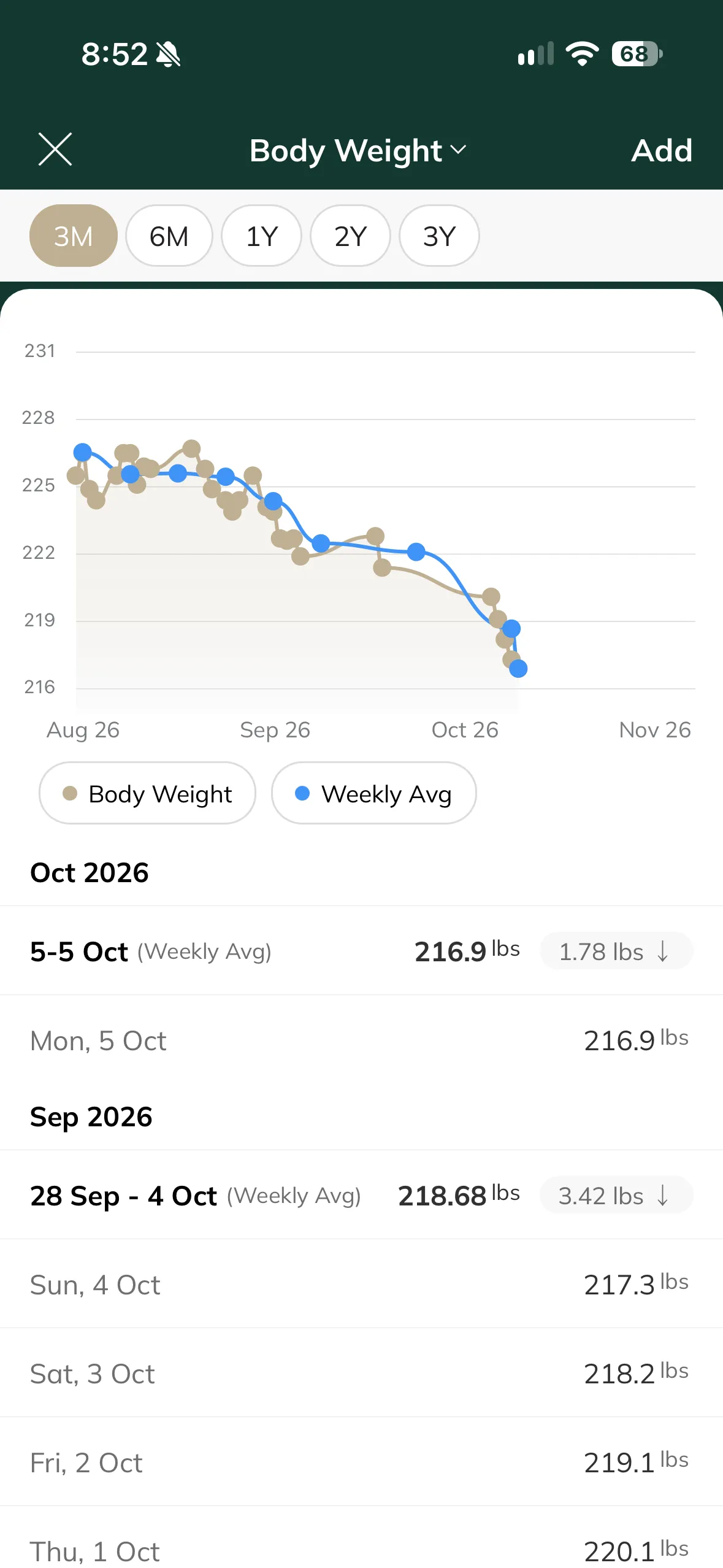
One of our clients is 67 and eats out for most of his meals.
He travels throughout the United States and internationally, and he recently spent about two weeks overseas.
A rigid meal plan would be almost useless for him.
So we did not try to make his life look like a fitness influencer’s life.
We simplified the system.
Protein and fiber became two of the numbers he tracks closely.
We built meals around getting those in first, then gave him flexibility with the rest based on where he was eating, what was available, and what the day required.
On July 14, he weighed 231 pounds.
On October 5, he weighed 216.9.
That is 14.1 pounds in just under 12 weeks.
And those 12 weeks included the international trip.
He did not get that result because every meal was perfect.
He got it because the system could travel with him.
That is process proof.
And it is the part most generic programs miss.
The Best Plan Is the One That Survives Your Life
A generic plan shows you what an ideal day looks like.
Coaching should solve for the days that are not ideal.
The airport.
The client dinner.
The late meeting.
The weekend with your wife.
The vacation.
The restaurant where you do not control the menu.
The week when training has to move.
The day when motivation is gone.
If your plan only works when your schedule is quiet and your environment is controlled, you do not have a plan.
You have a temporary experiment.
Your fitness should improve your life.
Your life should not have to revolve around your fitness.
That is why I do not think most successful men need more fitness information.
They need better management.
They need to know which numbers matter.
They need defaults that reduce decision-making.
They need rules for predictable exceptions.
And they need a system built around the life they actually intend to keep living.
That is what we do at Crestmont.
We do not hand successful men a generic meal plan and ask them to try harder.
We build the training, nutrition, recovery, and lifestyle system around the individual—their goals, schedule, travel, preferences, limitations, and real life.
Cracking Your Code - What to Do This Week
1. Define the numbers you are managing. Establish an appropriate calorie target or range, protein floor, and fiber floor instead of relying on “eat better” as the plan.
2. Build three defaults. Pick three meals or meal structures you can repeat with almost no thought. Make the right choice the easy choice.
3. Write your exception SOPs. Decide in advance how you will handle a restaurant meal, a travel day, and a disrupted schedule. Predictable problems should have predetermined responses.
4. Use one swap and one add. Make one food swap that improves the protein-to-calorie ratio, then identify one easy food you can add when protein or fiber is running low.
5. Audit friction, not character. When the plan breaks, do not immediately blame discipline. Ask what created the friction and change the system so the same failure is less likely next time.
You already know how to run a business.
The opportunity is to apply the same level of thinking to the body that is supposed to carry you through the life you worked so hard to build.
If your problem is not a lack of information but a lack of a system that fits the life you actually live, apply for coaching with me and my team at crestmont.fitness.
The Performance Edge is my weekly look at the training, nutrition, recovery, and decisions that help build a better-performing body.
Know someone who runs his company by systems but still runs his body by willpower? Send him this issue.
For a new issue every Wednesday, subscribe at crestmont.fitness/blog.
Steve Cutler
Founder, Crestmont
Research & Further Reading
[1] International Society of Sports Nutrition position stand: diets and body composition — Aragon et al., 2017
[2] Evidence-based recommendations for natural bodybuilding contest preparation: nutrition and supplementation — Helms, Aragon & Fitschen, 2014
[3] Protein Intake Greater than the RDA Differentially Influences Whole-Body Lean Mass Responses to Purposeful Catabolic and Anabolic Stressors: A Systematic Review and Meta-analysis — Hudson et al., 2020
[4] Carbohydrate quality and human health: a series of systematic reviews and meta-analyses — Reynolds et al., 2019
© 2026 Crestmont. All rights reserved. This publication is general educational information, not individualized medical advice.
